Canyon De Chelly
National Monument - Arizona
 In 1863,
while the War Between the States raged in the East,
legendary"Indian fighter" Kit Carson led a brutal campaign
against the Navajo of the Southwest, whose raiding parties
were seen as a threat by the United States government. One
Navajo stronghold was Canyon de Chelly (pronounced "d'SHAY,"
from a Spanish mispronunciation of the Navajo name for the
area, tsegi), a colorful canyon near present-day Chinle,
Arizona. Beginning in 1864, Carson, with the eager assistance
of the Navajo's traditional enemies, marched into the
beautiful, steep-walled canyon to destroy cornfields, hogans
(circular, domed structures made of mud and logs), and
orchards. Without food or shelter, the Navajo surrendered.
Thousands of them were forced to march 300 miles eastward
across New Mexico to a parched reservation where they were
held as prisoners of war. In 1863,
while the War Between the States raged in the East,
legendary"Indian fighter" Kit Carson led a brutal campaign
against the Navajo of the Southwest, whose raiding parties
were seen as a threat by the United States government. One
Navajo stronghold was Canyon de Chelly (pronounced "d'SHAY,"
from a Spanish mispronunciation of the Navajo name for the
area, tsegi), a colorful canyon near present-day Chinle,
Arizona. Beginning in 1864, Carson, with the eager assistance
of the Navajo's traditional enemies, marched into the
beautiful, steep-walled canyon to destroy cornfields, hogans
(circular, domed structures made of mud and logs), and
orchards. Without food or shelter, the Navajo surrendered.
Thousands of them were forced to march 300 miles eastward
across New Mexico to a parched reservation where they were
held as prisoners of war.
 Throughout the nearly five years on the reservation at
Fort Sumner, the Navajo people begged to be allowed to return
to the land they considered"the heart of the world." Of those
who survived the grueling "Long Walk," only half saw the day
their people returned to the canyon in 1868. Slowly, the
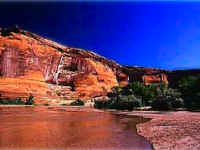
people rebuilt their lives. Today there are approximately 80
families living in Canyon de Chelly. You can see the plowed
fields and homes scattered about the canyon floor from
overlooks high above. Throughout the nearly five years on the reservation at
Fort Sumner, the Navajo people begged to be allowed to return
to the land they considered"the heart of the world." Of those
who survived the grueling "Long Walk," only half saw the day
their people returned to the canyon in 1868. Slowly, the
people rebuilt their lives. Today there are approximately 80
families living in Canyon de Chelly. You can see the plowed
fields and homes scattered about the canyon floor from
overlooks high above.
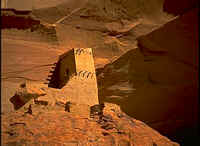
The national monument,
which actually includes Canyon del Muerto, Monument Canyon,
and Canyon de Chelly, has housed people for more than 1,500
years. Numerous pictographs, petroglyphs, and ruins tell the
tales of the people who once made their homes here. The style
of living has changed-from the circular pit houses of the
Basket Makers to the cliff dwellings of the Anasazi and
Pueblos to the hogans of the Navajo (who first came here in
the 1700s)-but the regard for the cliffs as a spiritual place
has always remained true.
 Although
its history is marred by incidents of massacre, forced
relocation, and abuse, Canyon de Chelly's overall effect is a
lasting sense of peace. Its beauty is subtler and more
profound than that of other parks in the U.S., and its
intricacies are entwined in the culture that calls it home.
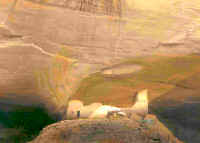
Highlights of the Canyon are Spider Rock, an 800-foot spire
said to be the home of "Spider Woman," and White House Ruin,
an ancient dwelling that allows visitors to understand how the
ancients lived and thrived here. Although
its history is marred by incidents of massacre, forced
relocation, and abuse, Canyon de Chelly's overall effect is a
lasting sense of peace. Its beauty is subtler and more
profound than that of other parks in the U.S., and its
intricacies are entwined in the culture that calls it home.
Highlights of the Canyon are Spider Rock, an 800-foot spire
said to be the home of "Spider Woman," and White House Ruin,
an ancient dwelling that allows visitors to understand how the
ancients lived and thrived here.
|


